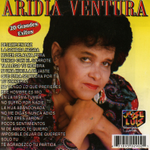
20 Grandes Exitos
1997 · Album · 20 tracks
Aridia Ventura — born around 1949 in Jacagua, a suburb of Santiago de los Caballeros, died in 2001 — was a Dominican bachata singer and songwriter, one of the genre’s first successful female voices and the first to reach that scale since Melida Rodríguez a decade before her.
A family of musicians
One of nine siblings, all of them musicians or singers, she was sent as a child to live with relatives in Santo Domingo, a common practice for large Dominican families. She began recording in 1975, at twenty-six, her first single produced by her brother Adriano Ventura, already a name in bachata for his 1968 Mexican-style ranchera «La novia ajena»; that debut single carried «No eres varón», a song she later re-recorded into a genuine hit.
«En la misma tumba»
Her second record, cut for the label Meregildo, made her a star: «En la misma tumba», a ranchera about wanting to be buried alongside a lover, became her biggest hit and remains her signature song.
Radio Guarachita
The song’s success caught the attention of Radhamés Aracena, who signed her to a five-year exclusive at a moment when bachata had had no comparable female star since Rodríguez. She cut at least eight LPs for him and got steady airplay, though Aracena mostly assigned her older boleros and rancheras rather than her own songs. She kept writing regardless — her merengue «Pa’ qué» became a hit for Fernando Villalona — and her despecho songs, sung from the point of view of betrayed women, earned her the nickname «La Verduga».
«Amargue», and after
After her contract with Aracena ended she kept recording into the 1980s and became a fixture of Santo Domingo’s Monday-night «Amargue» shows, helping bachata gain acceptance in the capital. A 1991 brain-tumor surgery left her partially blind and slowed her career just as a younger style of bachata was crowding out her generation; her last real hit, «Dinero» (1997), was cut with the guitarist Nelson Paredes, brother of Edilio Paredes.
Legacy
She died in 2001, one of the handful of women — with Rodríguez and Blanca Iris Villafañe before her — who built bachata’s audience before the genre had any real use for women at all.
1997 · Album · 20 tracks