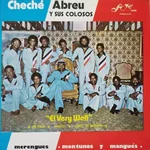
El Very Well
1980 · album · 6 tracks
Cheché Abreu —José Abreu Vargas, born on 26 July 1939 in Manoguayabo, Santo Domingo, and died in 2020— was a Dominican singer, guitarist and bandleader remembered as the man who named the mangué rhythm and, according to a 2007 tribute in the newspaper Diario Libre, the first Dominican act to fill New York's Madison Square Garden. Known as “El Queridísimo”, he ran his orchestra as a cooperative and spent its earnings on public works in his hometown.
Early years
He grew up poor in Manoguayabo, working in farming and construction as a child alongside his brothers, in a household his parents José Abreu Martínez and Rosa Herminia Vargas Germán held together on strict values. In 1961 he took up the guitar, bass, bongó and conga and, with a group of friends, formed «El Sexteto Manoguayabo». Its shows stopped during the civil war of 1965, when Abreu, a private in the navy, was confined to barracks until the fighting ended.
The mangué rhythm
Once the war was over he kept working with his own group and, in 1967, built it into a twelve-piece orchestra playing bolero, son montuno, salsa and merengue. Its first recordings came in 1968, the year Abreu also named a new rhythm, mangué, which he chose not to call merengue out of respect for the genre that already ruled the country's dance floors.
Cheché Abreu y sus Colosos
Billed as Cheché Abreu y sus Colosos, the orchestra released its first album, «Bandera dominicana», in 1970, followed by «Los grandes soneros» in 1976 and, in 1978 alone, «Canto a Santo Domingo», «Pruebe y compre mi salsa» and «Mi salsa». Its commercial breakthrough was «El very well» (1979), whose hits «Aquí estoy, mi vieja», «Raquel», «Llegó la mañana» and the title track were sung by Abreu, Peter Cruz and El Profeta. The 2007 tribute in Diario Libre credits the orchestra as the first Dominican act to fill Madison Square Garden.
«La Negra Pola»
In 1980 a thirteen-year-old named Pochy Familia approached Abreu after a performance on Radio Televisión Dominicana and handed him the lyrics of a merengue he had written; the two set it to music together on a guitar that same day. «La Negra Pola» became the song that defined the rest of Abreu's career. Years later, by then a leading merenguero fronting his own orchestra, Pochy Familia invited Abreu to re-record it, and the song became a hit a second time. A live recording of «El Negro Chango» from the 1980s credits Yoskar Sarante and Angelito Adames on backing vocals.
Later recordings and a stroke
The orchestra kept recording into the 1990s, with «El príncipe de la salsa», «Colosalmente», «Mejor que nunca», «El telecable», «Aquí me quedo», «El Negro Chango» and «El regreso del sonero». In 1995 a stroke forced Abreu to disband the group; he recovered and kept working at a slower pace, and roughly two decades later a second episode left him without most of his motor function, though he went on performing as his health allowed.
Community work
More than a bandleader, Abreu ran his orchestra as a cooperative in which every member drew the same salary as its owner, and he put its earnings into public works around Manoguayabo: an expansion of the local school from five classrooms to eleven, a community club, a parish hall, the renovation of the church in neighbouring Bayona, and, working with the political leader José Francisco Peña Gómez, a water tank and a telephone system for the area. He also helped reopen a savings and loan cooperative serving Bayona, Hato Nuevo and Palavé.
Legacy
Abreu was honoured at the Asociación de Cronistas de Arte's nominations gala in 2008 and recognised by the Ministry of Culture in 2015. He is remembered less for a single catalogue of hits than for the rhythm he named and for a model of running an orchestra as a shared enterprise; «La Negra Pola» outlived him twice over, first as his own signature song and later as Pochy Familia's tribute to the man who first recorded it.
1980 · album · 6 tracks
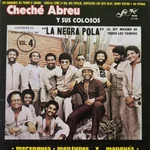
1981 · album · 6 tracks